Technicians in the Vehicle Assembly Building at NASA's Kennedy Space Center in Florida are essentially done with the latest round of X-ray type image scans of space shuttle Discovery's external fuel tank.
The computed radiography images of all 108 support beams, called stringers, on the outside of the external tank’s intertank section, which technicians began taking Sunday, are being evaluated by engineers.
However, preliminary analysis indicates small cracks were detected on the tops of three stringers on panel 6, which is on the opposite side of the tank from Discovery. The newly detected cracks currently are under evaluation and there has been no decisions on what affect, if any, the these cracks will make on future plans.
The new data, along with previous testing and analysis, will help engineers and managers determine what caused other small cracks on the tops of two stringers during Discovery’s launch countdown on Nov. 5.
Space Shuttle Program managers are meeting this afternoon (December 30, 2010) to decide whether testing and analysis indicate modifications are needed on some of the stringers. If required, modifications would begin next Monday (Jan. 3, 2010).
X-ray radiography work on the external tank
Image Credit NASA
Artist rendering of Taurus II on the
launch pad at the Wallops Flight Facility Image Credit: Orbital
Artist rendering of Taurus II Launch Image Credit: Orbital
The second test 55-second test firing of the liquid-fueled Aerojet AJ26 engine at NASA's Stennis Space Center in Mississippi on December. 17, 2010. Test firing of 55 seconds on E-1 test stand and into 27-foot-deep flame deflector trench. One in sequence of development tests performed by NASA Stennis. Next hot fire test to verify tuning of engine control valves. Stennis has a long history of rocket engine testing going back through all the space shuttle engine tests and the Apollo Lunar program.
Taurus II
Two Aerojet AJ26 engines each with independent thrust vectoring will be used for first stage propulsion of Orbital Sciences Corp.'s Taurus II launch vehicle.The Aerojet AJ26 engine is an oxidizer-rich, staged-combustion LO2/Kerosene engine that achieves very high performance in a lightweight compact package. It is based on the NK-33 engine originally designed and produced in Russia for the Russian N1 lunar launch vehicle. Aerojet has developed and delivered over 1300 bipropellant engines typically using either monmethyl hydrazine (MMH) or hydrazine (N2H4) as fuel with nitrogen tetroxide (NOT) as oxidizer. Oxidizer and fuel streams meet and react to produce thrust. The Taurus II medium-class space launch vehicle is being developed to boost payloads into a variety of low-Earth and geosynchronous transfer orbits and to Earth escape trajectories. Taurus II will also be capable of supporting mid-inclination and polar orbiting spacecraft weighing 10,500 lbs. and 5,500 lbs., respectively.
Orbital Sciences Corporation
Orbital Sciences Corporation of Dulles, Va. is under a $1.9 billion commercial contract with NASA to provide eight cargo missions to the International Space Station from 2011 through 2015. NASA Stennis tests the rocket engines in the partnership agreement. The first Taurus II mission will be flown in support of NASA's Commercial Orbital Transportation Services (COTS) cargo demonstration to the International Space Station. Taurus II Initial Launch Capability (ILC) is expected in the third quarter of 2011.
Aerojet Engine History in the News
Voyager 1 and Voyager 2 were launched in 1977, and are the oldest operational spacecraft. At launch, each spacecraft carried two propulsion systems, a Delta-V system, including four 100 lbf and four 5 lbf monopropellant hydrazine thrusters made by Aerojet, and an attitude control system including 16 0.2 lbf monopropellant hydrazine thrusters. The Delta-V systems have long since been jettisoned, but the attitude control systems remain operational today. The 100 lbf thrusters are the original version of the thrusters intended for Orion’s crew module and the 0.2 lbf thrusters are the original version of the thrusters currently in use for the Global Positioning System Block IIR, and are similar to those newly in service for GPS Block IIF.
From the Earth to orbit about 400 kilometers. It is this distance that now separates families and friends of the astronauts. While they will work in space, on Earth they will have to wait. And the wait is always harder. Six months of weightlessness - 152 days apart.Occasional phone calls and conversations directly connected with the Mission Control Center. Brief e-mails - so in the future. And now, before the start, separated by thickglass, they are trying to convey your feelings to those who remain on Earth. Who waves his hand, who pulls a stuffed toy - a talisman, sends a secret, one they know the signs or just looking, mentally trying to convey their words to loved ones. Space, as a test of the senses. Separation, as a proof of love. What can be more than signs of love from outer space?
Includes video clips of Soyuz TMA-20 launch on Dec 17, docking with ISS, and news conference with some of the memorable moments, especially ISS Flight Engineer Catherine Coleman talking with her family. Watch how stuffed animals are used between the astronauts and family members, especially the smiles :))
Integrated Launch Vehicle (ILV)
Proton-M/Breeze M/KA-SAT
on Launch pad
Image Credit: Khrunichev
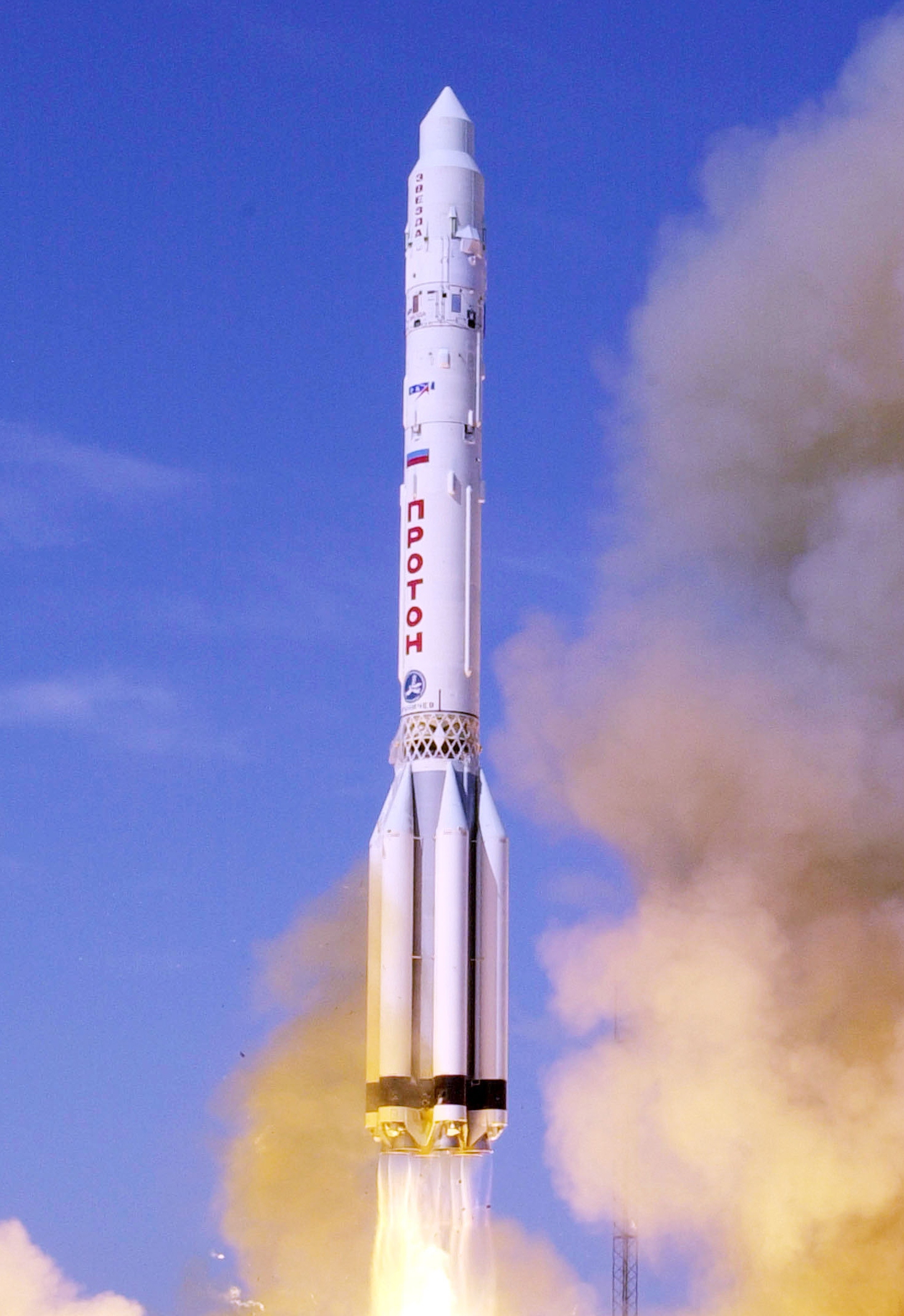
Roscosmos will launch Proton-M with Breeze M upper stage and Eutelsat's KA-SAT spacecraft Dec 27, 2010 at 00:51 Moscow time from launch complex 200 at Baikonur Cosmodrome, Kazakhstan. TsENKI provides live TV and Internet broadcasts of space launches from Baikonur Cosmodrome. The launch will be televised on the internet at http://www.tsenki.com/broadcast/
Moscow Standard Time (MSK) is 3 hours ahead of UTC, or UTC+3. Launch time is Dec 26, 2010 21:51 UT. Integrated Launch Vehicle (ILV) = Proton-M with Breeze M upper stage and KA-SAT
KA-SAT deployed
KA-SAT is a high-capacity Ka-band multi-beam satellite owned by European Telecommunications Satellite Organization (Eutelsat) configured with over 80 spotbeams. Spot beams draw smaller cells on the ground (beam footprint) and more efficiently use satellite transmission power. KA-SAT will be parked in geo-synchronous obit at at 13° E (some references say 9 deg East) near three Eutelsat HOT BIRD Ku-band broadcasting satellites. KA-SAT was built by Astrium on the Eurostar E3000 platform and has a 15 year life expectancy. KA-SAT is the first European satellite that will operate exclusively in high capacity Ka-band frequencies. With its High Throughput of 70 Gbps, KA-SAT is ranked as the world's most powerful satellite. It will provide satellite-delivered broadband and data services across Europe and the Mediterranean Basin.
Spot Beam Earth Coverage over Europe with KA-SAT
Ka-band:
Downlink 27.5 GHz - 30.0 GHz
Uplink 17.7 GHz to 20.2 GHz
Proton-M Booster Rocket
Proton M Rocket Booster
Overall height 42.3 m (138.8 ft).
Three stages
Built by Khrunichev State Research and Production Space Center
A Proton M/Breeze M stack was first launched on April 7, 2001
First stage
Length 21 m
Diameter 7.4 m
Six RD-276 engines
Thrust 11.0 MN (2,500,000 lbf).
central fuel tank containing the nitrogen tetroxide (NTO) oxidizer surrounded by six outboard fuel tanks containing Unsymmetrical dimethylhydrazine (UDMH) hypergolic fuel
The first three stages of the Proton-M use a standard ascent profile to place the Breeze M upper stage with KA-SAT into a sub-orbital trajectory. Breeze M maneuvers the orbital unit to a circular parking orbit, then to an intermediate orbit, followed by a transfer orbit, and finally to a geostationary orbit.
Proton-M first stage showing six RD-276
engines and UDMG fuel tanks
surrounding central N2H2 oxidizer tank
Image Credit: Roscosmos
Set up of Proton-M with Breeze-M upper stage
and payload KA-SAT at Baikonur Cosmodrome,
Kazakhstan site 200 launch facility
YouTube Video by Roscosmos
Proton-M/KA-SAT Launch Team
Image Credit Khrunichev
Indian Space Research Organisation (ISRO) launched GSLV-F06 earlier today at 4.04 p.m. IST but at approximately 47 seconds after lift off, the rocket deviated from its path when the gimbal steering system failed and the rocket exploded several seconds later as the GSLV reached an altitude of approximately 12 km and 4.5 km down range and fell into the Bay of Bengal.
This is the third unsuccessful launch in seven launch attempts of the ISRO GSLV. The launch of GSLV-D3 on April 15, 2010 failed due to a fuel pump anomaly on its cryogenic third stage. The launch of GSLV-F02 on July 10, 2006 failed.
GSAT-5P Satellite launch fails
Image Credit: IBN Live
GSAT-5P Satellite launch fails
Image Credit: IBN Live
GSAT-5P Satellite launch fails
Image Credit: IBN Live
GSAT-5P Satellite launch fails
Image Credit: IBN Live
GSLV-F06 Launch Failure Dec 25, 2010
Image Credit: Xinhua News
GSLV-F06 Launch Failure Dec 25, 2010
Image Credit: Xinhua News
JAXA is scheduled to launch its H-IIB Launch Vehicle No. 2 with H-II Transfer Vehicle 2 (HTV2) on January 20, 2011 at 3:29 p.m. (JST) from Tanegashima Space Center.
H-IIB Launch Vehicle No. 2 (H-IIB F2)
at the Tanegashima Space Center
Image Credit JAXA
A sucessful cryogenic test of the H-IIB Launch Vehicle No. 2 (H-IIB F2) was conducted at the Tanegashima Space Center on December 16, by JAXA and Mitsubishi Heavy Industries Ltd.
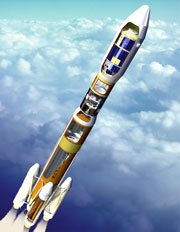
H-IIB Launch Vehicle
Image Credit JAXA
H-IIB Launch Vehicle
Height: 56.6 m
Mass 531 t
Inertial Guidance
First stage:
LE-7A LOX/LH2 with 2,196 kn thrust - Gimbal attitude control
four Solid Rocket Boosters (SRB-As) using Polybutadiene composite solid propellant with 9,220 kn thrust
Second Stage:
LE-5BLOX/LH2 with 137 kn thrust - Gimbal gas jet attitude control system
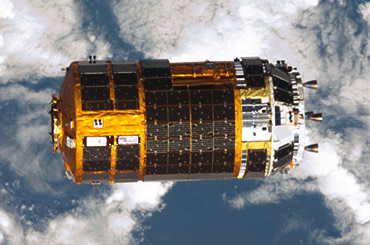
H-II Transfer Vehicle 2 (HTV2) named KOUNOTORI 2
Image Credit JAXA
H-II Transfer Vehicle 2 (HTV2) named KOUNOTORI 2
Image Credit: NASA
H-II Transfer Vehicle 2 (HTV2) named KOUNOTORI 2 is an unmanned cargo transporter to the International Space Station) has been thoroughly inspected, and propellants loaded. Battery charge and loading on to H-IIB Launch Vehicle No. 2 remain before launch.
Scheduled date of launch: January 20 (Thursday), 2011 (Japan Standard Time, JST)
Launch time: ~ 3:29 p.m. (JST)
Launch windows: January 21 (Fri.) through February 28 (Mon.), 2011 (JST)
Launch Site: Yoshinobu Launch Complex at the Tanegashima Space Center
"The best environment where human beings can exhibit their utmost ability is in relaxed conditions with a comfortable level of tension against carelessness." - Yoshihiko Torano / JAXA HTV Project Manager
Indian Space Research Organisation (ISRO) is scheduled to launch GSAT-5P on December 25, 2010 from launch pad number 2 at Satish Dhawan Space Centre on a GSLV-F06 geosynchronous satellite launch vehicle. GSAT-5P is an advanced communications satellite to replace its INSAT-2E for telecommunication, television and meteorology services and will expand existing telecommunication and television bandwidth.
GSAT-5P
Fifth in the GSAT series
Developed by the ISRO Satellite Centre in Bangalore
C-band communication satellite
12 normal C-band transponders
six extended C-band transponders
scheduled launch Dec 25, 2010
mass 2,310 kg
mission life 12 years
GSLV Image Credit: ISRO
Geosynchronous Satellite Launch Vehicle (GSLV)
Height: 49 m
lift off weight: 414 tonne
maximum diameter of 3.4 m at the payload fairing.
First stage comprises S125 solid booster with four liquid (L40) strap-ons.
Second stage (GS2) is liquid engine
Third stage (GS3) is a cryo stage.
Lift off thrust of 6573 kn.
Payload range: 2000 – 2,500 kg
INSAT-2E
Image Credit ISRO
INSAT 2E
launched by Ariane-42P launch vehicle (Ariane 4 with two solid-fuel boosters) of Arianespace from Kourou, French Guyana on April 3, 1999 at 3.33 am IST
last satellite in the second genaration INSAT-2 series built by ISRO
Geostationary Orbit at 83 degree East Longitude
440 nt thrust Liquid Apogee Motor (LAM) built by Liquid Propulsion Systems Centre, Thiruvananthapuram
perigee 32,100 km
apogee 35,925 km
inclination to equator 0.15 deg
orbital period ~ 22 hours 27 minutes
continuously remains within the radio visibility of INSAT Master Control Facility at Hassan in Karnataka